

Levelling Feet FAQ: Answers on Selection, Load Capacity and Materials
Levelling feet are essential components in mechanical and plant engineering. They ensure stable machine positioning, enable precise levelling, and provide even load distribution – even on uneven floors or under dynamic loads.
In this FAQ section, we answer frequently asked questions about levelling feet – from correct selection and technical properties to typical applications in mechanical engineering and conveyor systems.
The following questions will help you find the right levelling foot for your specific application.
Key Selection Criteria for Levelling Feet
Load Capacity
Depending on their design and size, levelling feet can support loads ranging from a few kilograms up to over 70 kN.
Materials
Stainless steel, steel, or plastic – selected based on the operating environment.
Function
Machine levelling, reliable load distribution, and vibration reduction.
Applications
Used in mechanical engineering, conveyor technology, as well as food and pharmaceutical industries.
Basics of Levelling Feet
Levelling feet ensure stable positioning of machines and equipment. They compensate for uneven floors, enable precise alignment, and distribute loads evenly across the ground. Versions with rubber pads can additionally reduce vibrations and improve stability.
For applications with higher dynamic or asymmetric loads – for example in industrial robot installations – the Teknofix levelling feet from MOVET are particularly suitable. They allow secure anchoring under vertical and dynamic forces and offer a cost-effective alternative to custom-engineered mounting solutions.
Levelling feet are used across many areas of mechanical and plant engineering. They provide stable positioning, precise alignment, and even load distribution for machines and equipment.
Typical applications include:
- Mechanical engineering and production systems
- Conveyor technology and packaging machines
- Food and beverage industry
- Pharmaceutical and chemical plants
- Robotics and automated production lines
Size & Load Capacity
The load capacity of a levelling foot is calculated by dividing the total machine weight by the number of support points. In addition, a safety factor of at least 1.5 should be applied. For dynamic loads or strong vibrations, a higher safety margin is recommended.
For MOVET levelling feet, a safety factor between 3 and 4 is typically used. This means that the actual load-bearing capacity of the components is significantly higher than the stated nominal load, providing an additional safety reserve for industrial applications.
Typical thread sizes for levelling feet range from M12 for smaller machines up to M36 for heavy-duty applications. In many industrial setups, M16, M20, or M24 are commonly used. The appropriate thread size mainly depends on the required load capacity, installation height, and machine design.
The MOVET product range includes levelling feet with thread sizes from M6 to M42, covering applications from light machinery to heavy-duty systems.
Materials and Designs
Levelling feet are generally divided into rigid and articulated types.
Rigid levelling feet have a fixed spindle and are suitable for applications with flat installation surfaces and uniform loads.
Articulated levelling feet feature a movable spindle, allowing the foot to adapt to sloped or uneven floors. Depending on the design, compensation angles of up to 30° are possible.
Depending on requirements, spindles are available in steel, stainless steel, or V4A (AISI 316). Diameters and base plates are also available in various sizes. Custom dimensions and special designs are available from MOVET on request.
The operating environment is a key factor when selecting levelling feet, as it directly affects material choice, design, and functionality.
- Moist or corrosive environments: use stainless steel or V4A (AISI 316)
- Hygienic areas: hygienic levelling feet with 3-A or USDA certification
- Electrically conductive applications: dissipative materials to prevent static charge
- Vibration exposure: levelling feet with damping elements or EPDM pads
In hygienic applications, smooth surfaces prevent the accumulation of contaminants and reduce cleaning effort.
MOVET offers levelling feet in various materials and designs, tailored to specific environmental requirements.
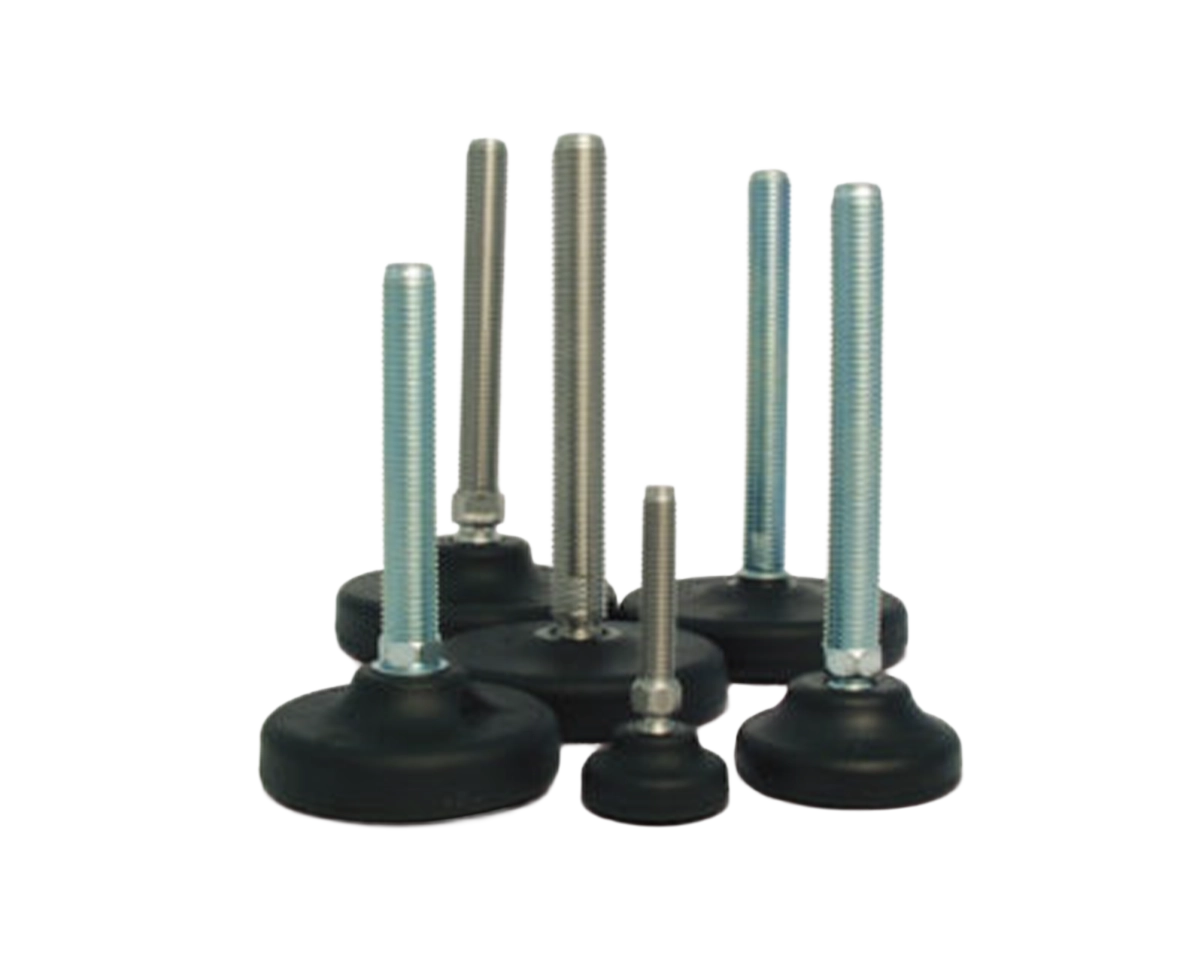
Depending on the application, levelling feet are made from stainless steel, steel, or plastic. Variants with vulcanized anti-slip pads or vibration-damping elements are also available.
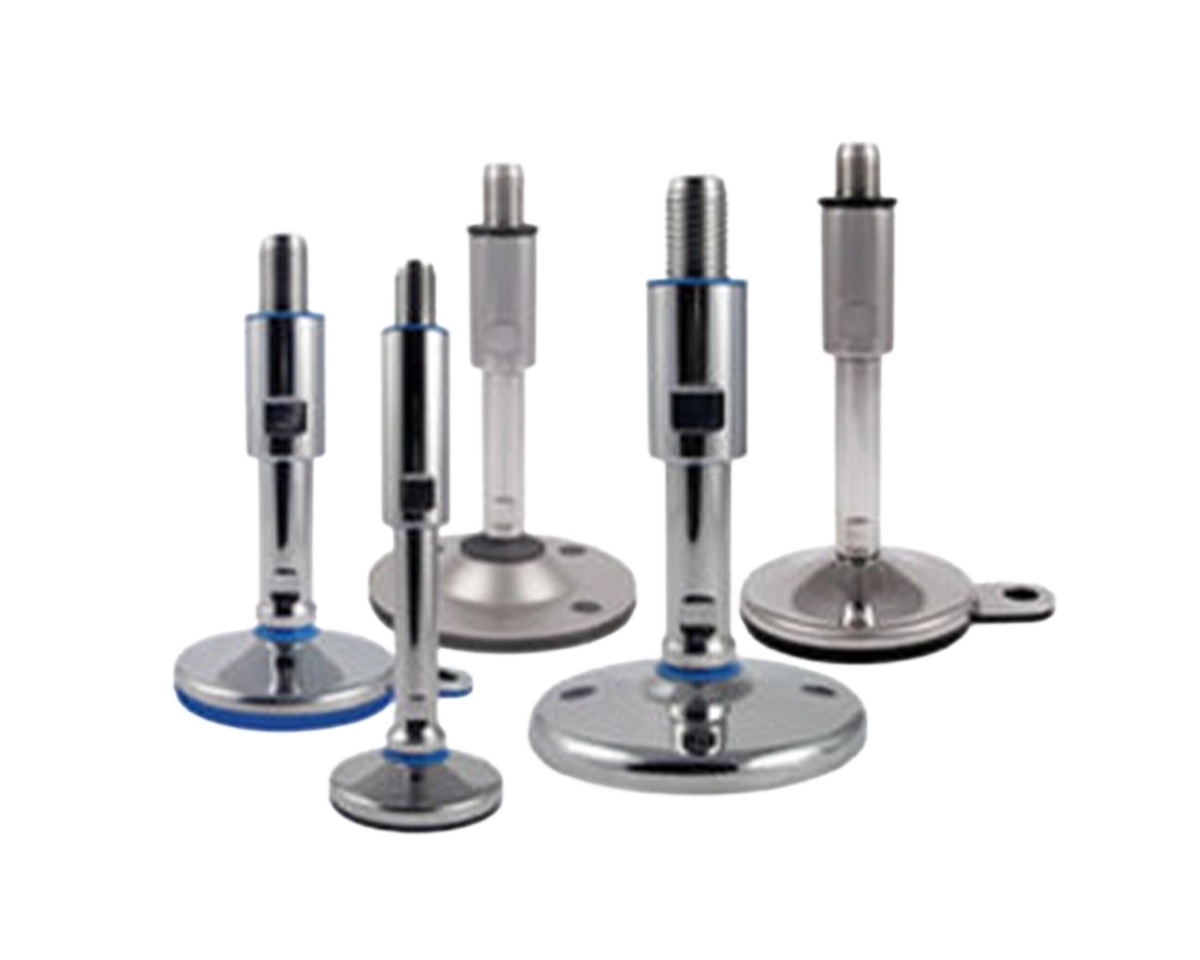
Stainless steel levelling feet are primarily used in moist or corrosive environments. Typical applications include the food industry, pharmaceutical plants, or production areas with intensive cleaning processes. Stainless steel offers high corrosion resistance and often meets hygienic requirements.
In applications without increased hygiene or corrosion requirements – such as machines in dry production environments – levelling feet made of steel, sheet metal, or plastic can also be used. These variants are often more cost-effective and sufficient for many industrial applications.
The difference between full thread and partial thread lies in the design of the threaded spindle.
Levelling feet with full thread have a spindle where the thread runs along the entire length. This allows flexible adjustment and use across different installation heights and is commonly used in general mechanical engineering.
Levelling feet with partial thread only have a threaded section in the upper part of the spindle, while the remaining area is smooth. This design is often used in hygienic applications, as it reduces exposed thread areas and improves cleanability.
The appropriate version depends on the application, hygiene requirements, and required adjustability.
Hygienic levelling feet are specifically designed for environments with high hygiene requirements. They feature smooth surfaces, sealed designs, and are typically made of stainless steel. This makes them easy to clean and prevents the accumulation of dirt or bacteria.
Hygienic levelling feet from MOVET are developed for use in sensitive production environments and comply with USDA and 3-A Sanitary Standards. The surface roughness is below Ra 0.8 µm, ensuring excellent cleanability and maximum hygiene safety.
Function and Technology
The compensation angle describes how well a levelling foot can adapt to sloped or uneven surfaces. The joint between the spindle and base plate allows levelling feet to compensate for floor irregularities and ensure even load distribution.
Depending on the design, different articulation angles are available. MOVET levelling feet offer compensation angles of 0°, 4°, 5°, 8°, 10°, 15°, 16°, and up to 30°, depending on the series.
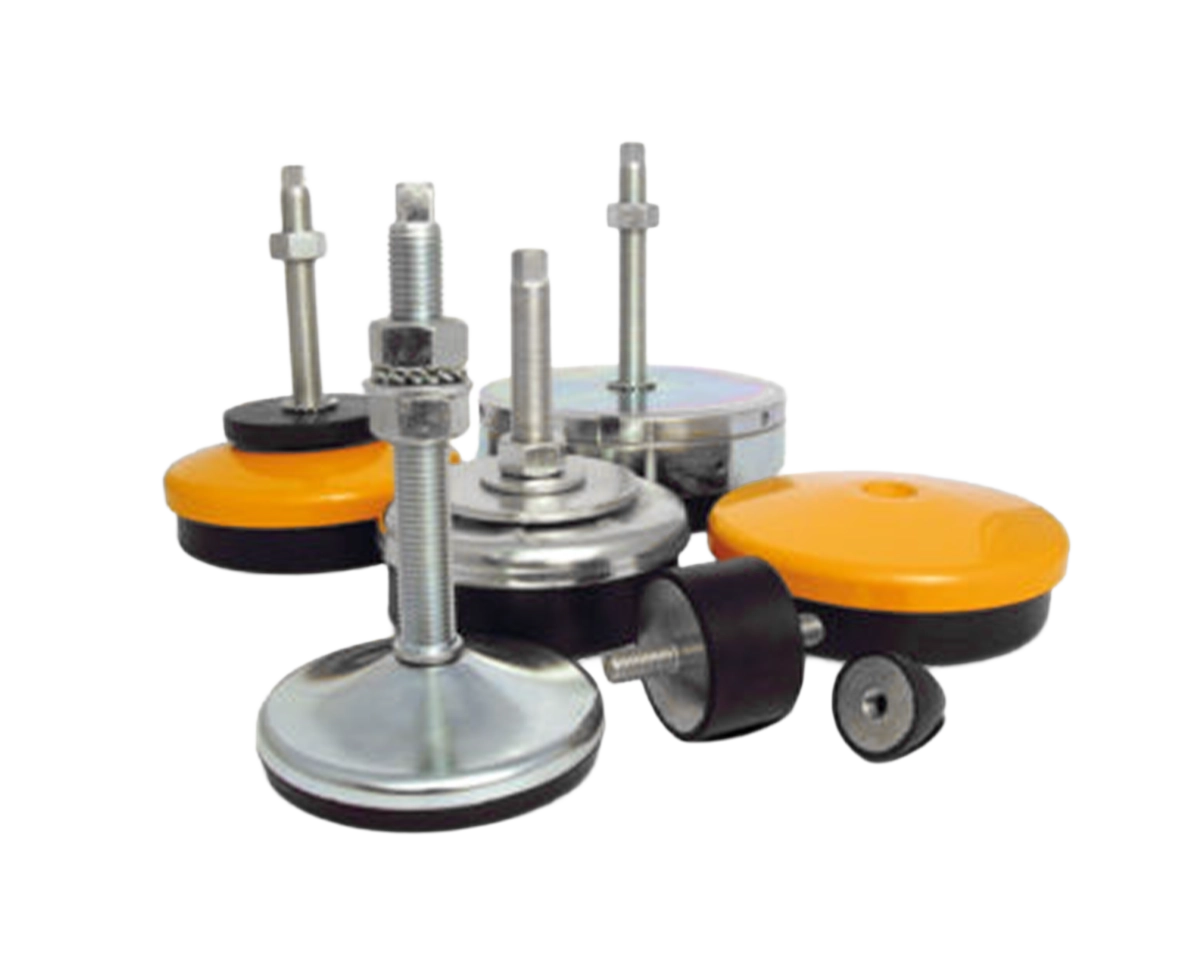
Depending on the design, levelling feet can effectively reduce vibrations and shocks, improving stability and extending machine lifespan.
A common solution is levelling feet with vulcanized rubber pads or anti-slip coatings. These reduce vibrations and prevent unwanted machine movement.
Additional mounting elements can also be used:
- Mounting brackets: for secure floor anchoring
- Levelling screws: for stable connection between machine and ground
- Hollow-body levelling feet: for handling higher dynamic loads
Depending on the design, loads of up to 100,000 N are possible. For lighter applications, simple rubber pads are sufficient, while heavy vibration environments require specialized damping solutions.
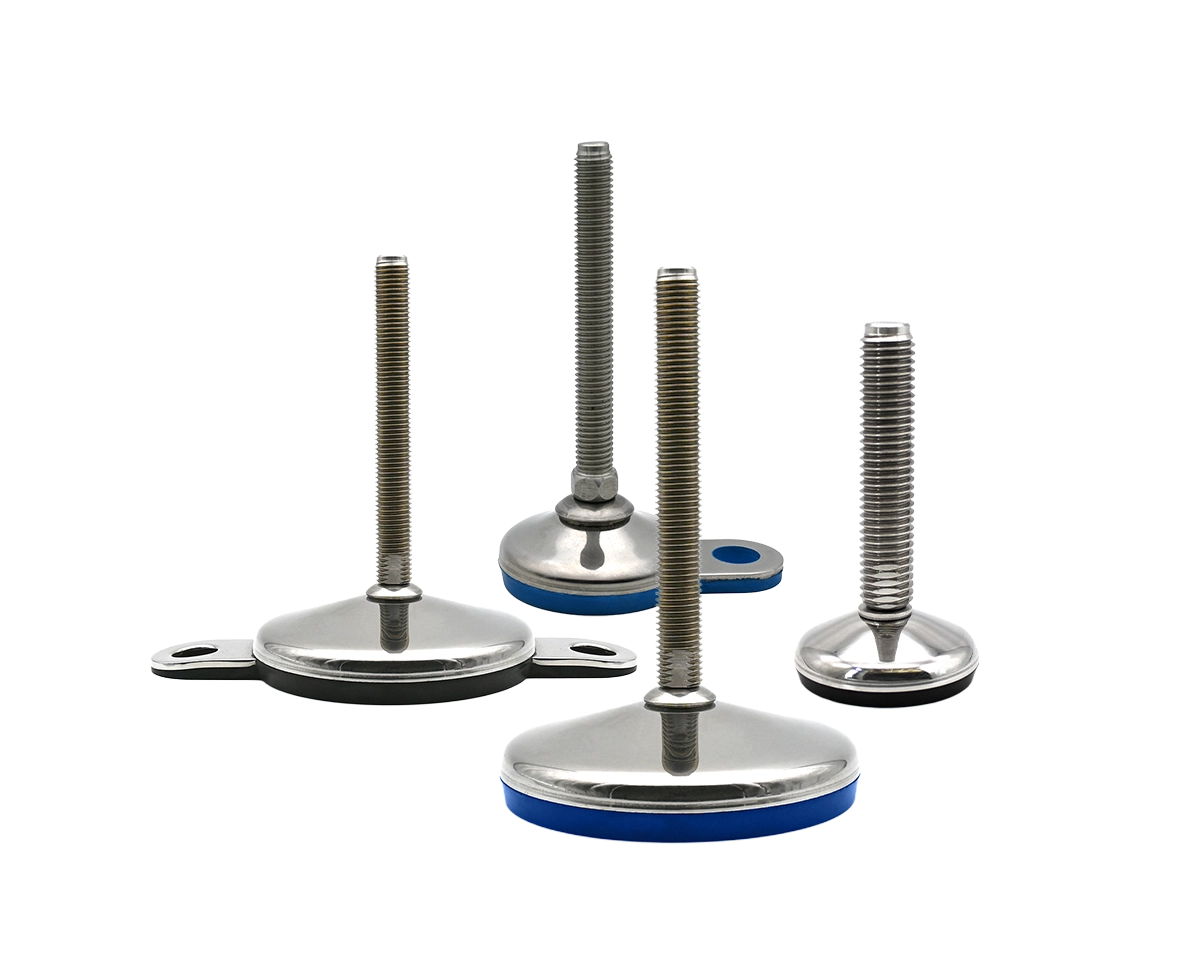
Vulcanization refers to the permanent bonding of an elastomer layer to the base plate of a levelling foot. This creates a durable rubber surface that improves slip resistance and reduces vibrations.
Vulcanized levelling feet are particularly useful when machines need secure positioning, slight unevenness must be compensated, or additional damping is required. They are commonly used in vibration-prone applications, on sensitive floors, or where increased stability is required.
Installation and Application
A machine is properly levelled by first positioning all levelling feet evenly and then adjusting them step by step to the desired height. Alignment should be checked using suitable measuring tools such as a spirit level or precision level.
It is important to distribute the load as evenly as possible across all support points. After alignment, the levelling feet should be securely fixed, and the machine position should be rechecked. For uneven floors or sloped surfaces, articulated levelling feet significantly simplify the levelling process.
Further Information on Levelling Feet
Levelling Feet Overview: Types and Applications
| Type | Design | Material | Typical Application | Compensation Angle | Key Features |
|---|---|---|---|---|---|
|
Plastic levelling feet | Plastic with steel or stainless steel spindle | Light to medium-duty machines | 4° / 16° / 30° | Optional anti-slip rubber, wide range of thread sizes |
|
Stainless steel levelling feet | Stainless steel | Food industry, pharmaceutical sector, hygienic environments | 5° / 10° / 15° | Corrosion-resistant, hygienic design |
|
Vulcanized levelling feet | Stainless steel or steel | Machines exposed to vibration | 10° | Rubber pad reduces vibrations |
|
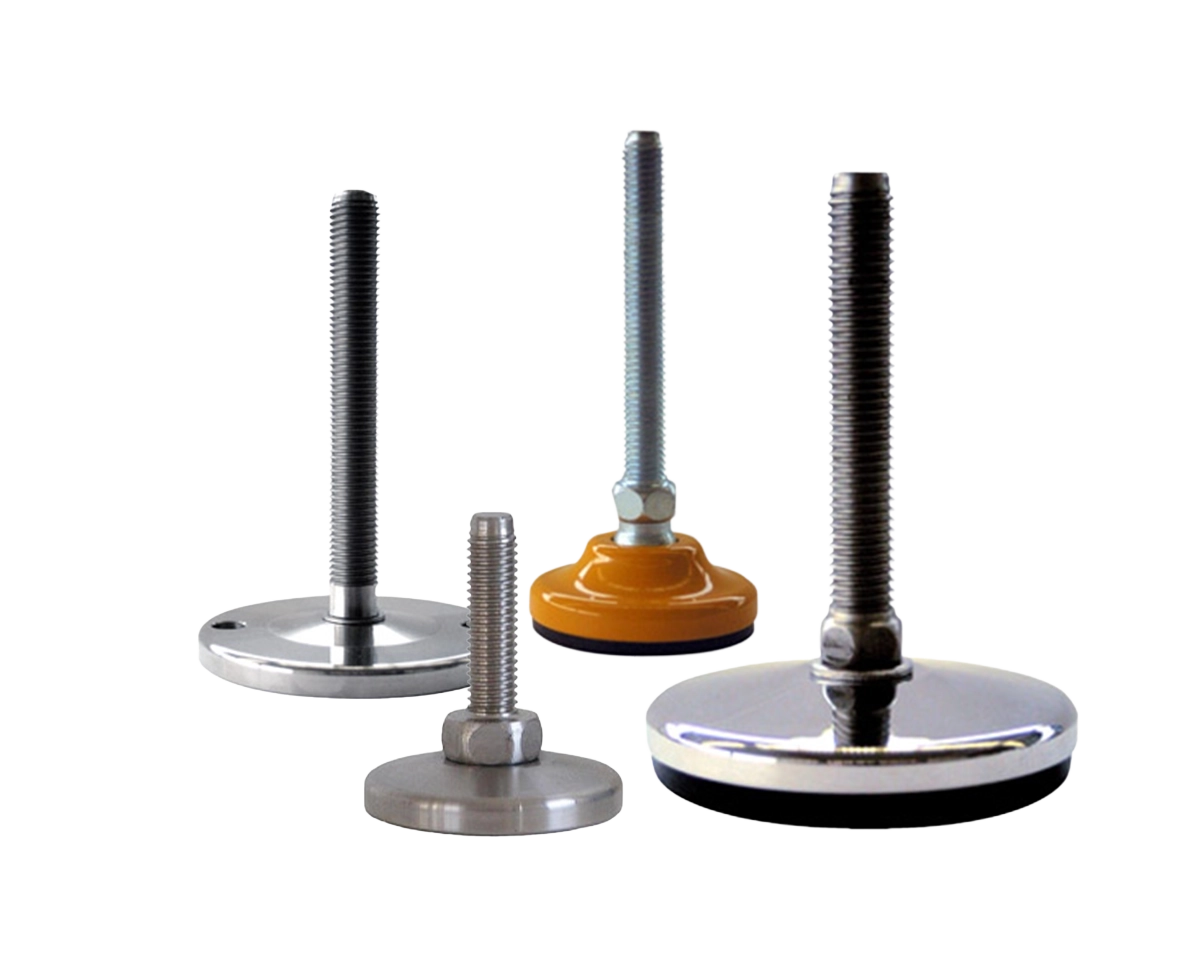
Anti-vibration levelling feet | Steel or stainless steel with elastic pad | Machines with vibration or moving components | 0° / 5° | Reduces vibration and improves stability |
|
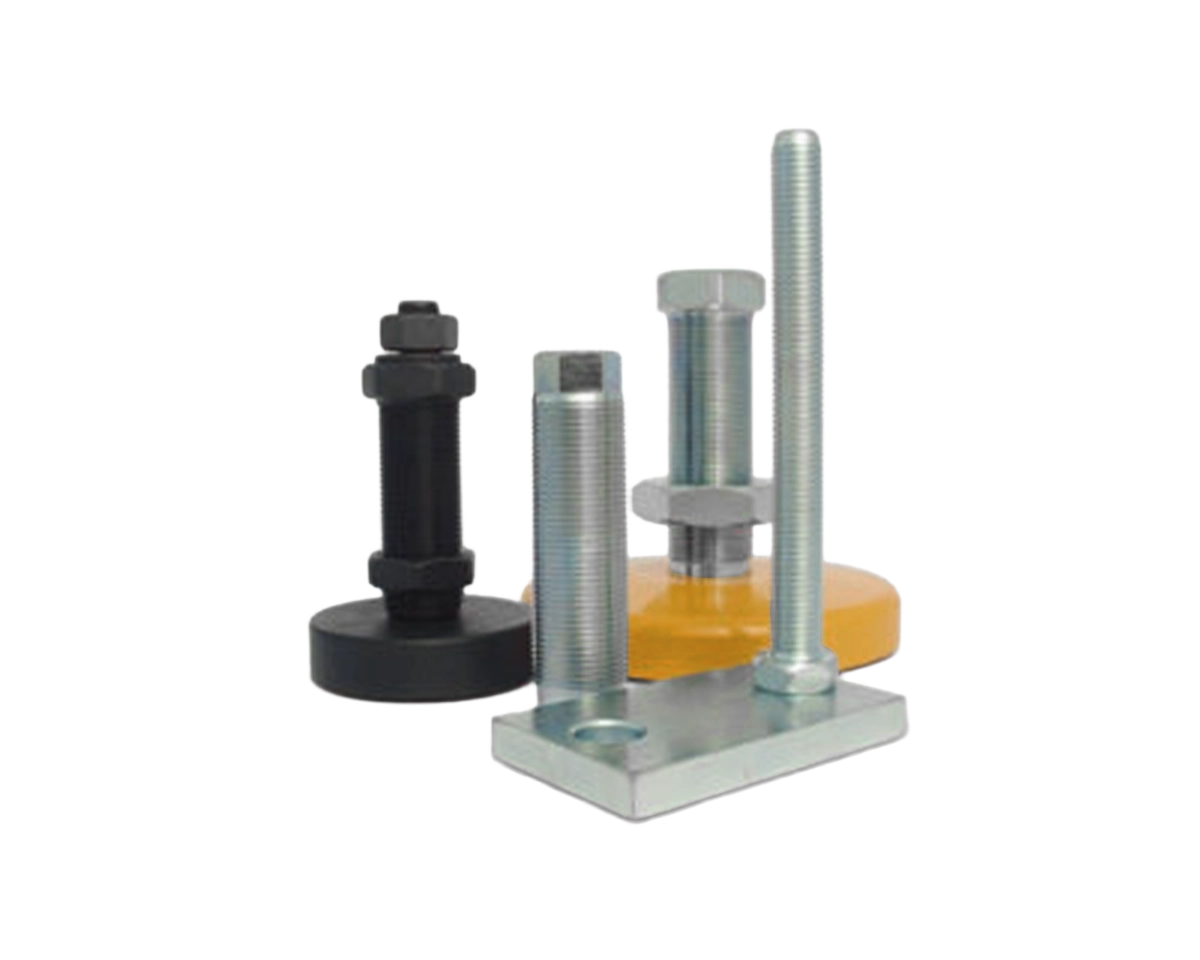
Heavy-duty levelling feet | Steel or stainless steel | Heavy machinery and industrial systems | 0° / 10° / 30° | High load capacity |
|
Teknofix levelling feet | Steel or stainless steel | Robot mounting, dynamic loads | 0° / 5° / 10° | Floor fixation, high stability under vertical forces |
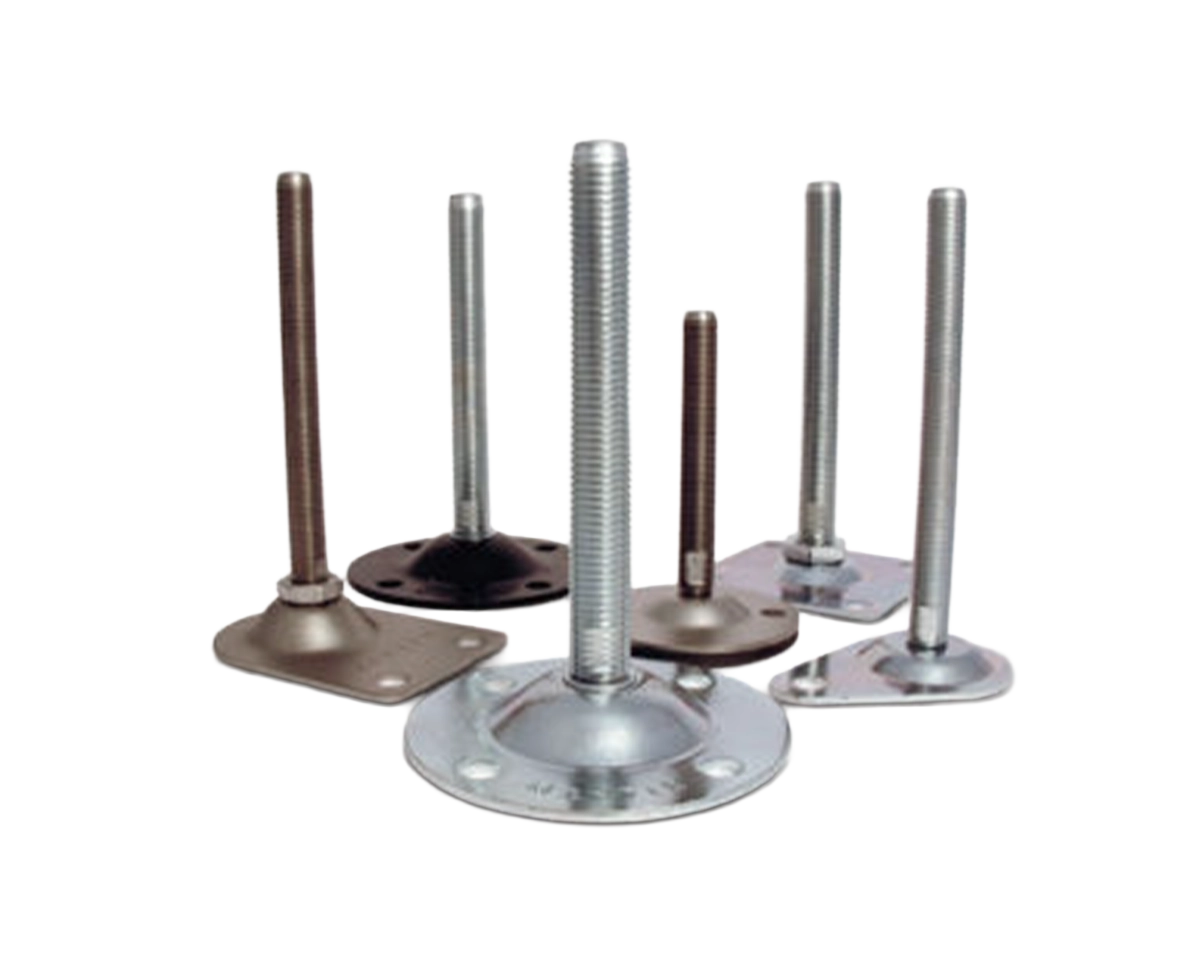
| CNC levelling feet | Steel or stainless steel | Machine tools, CNC machining, precision manufacturing | 0° / 5° / 10° | High rigidity, precise levelling, low-vibration setup | |
|
Levelling feet with sheet metal base | Steel or stainless steel | Simple machine installation | 0° / 8° | Flat design |
Advice & Contact
Do you have any questions or would you like to find out more about the benefits of MOVET Machine Feet? Our team of experts will be happy to help you.
Phone: +49 (0) 7181 - 980 32 00
You can also use our contact form for an individual enquiry.